




RIP, Amy's Blog: 1997 to 2021
I have two intense books I'm completing, and I've been increasingly unable to put the effort into blogging that I have done for years.
So, yes, it's time to close up shop: last night, December 31, 2021.
I will keep posting columns on my site (in the section for that) as well as other work I do (such as my November 2021 TED talk that will be out in February 2022).
I love you all for your comments and debate here over all these years, and I'm also grateful for the friendship of a number of you.
Thank you for inspiring me to post (and post and post!) here for all these years.
Erasing History Is Not The Virtue They Think It Is
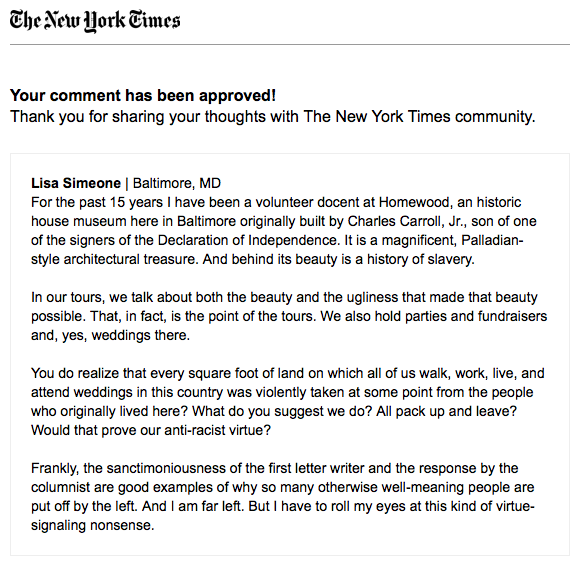
I love Lisa Simeone, one of my colleagues in standing up for individual rights (against the TSA).
She emailed me about a comment she left in the NYT and allowed me to post the comment and our email exchange.
Lisa's email to me:
-----Original Message-----
From: Lisa Simeone
To: Amy Alkon
Sent: Thu, Dec 30, 2021 6:29 am
Subject: Fw: Your Comment on I'm Invited to a Destination Wedding at a Plantation. What Do I Do?Amy, thought you would appreciate. I'm getting slaughtered by the wokerati in the comments section -- ha ha! (Of course I have the guts to write under my own name, unlike all these virtue-signaling wankers excoriating me, most of them erecting straw man arguments and putting words in my mouth, to boot.)
Even so, my comment has risen to the #1 Top Reader Pick, by a mile. Ha! Take that, insufferable, sanctimonious, faux-liberal twits!
What have any of these people actually done to advance the cause of racial justice?? My money says nothing. All they do is pontificate -- anonymously -- on websites and act holier-than-thou. I've put my ass on the line and paid a heavy price for it, personally and professionally:
My reply:
I love the hell out of you -- for what you wrote and for always standing up for sanity (along with individual rights).I, too, always write comments under my own real name. Because you are besieged by many human fleas does not make them any less fleas.
LOVE that it's now the top comment.
And you're completely right about the "doing" part.
My favorite is when people call me "racist" for not parroting the trendy neo-racism of the moment. Meanwhile, though I'm on book hiatus a bit longer, I volunteer as a mediator -- doing free dispute resolution for mostly black and Latino clients.
I spend hours and hours and hours working to see they have "access to justice" -- meaningful resolution for their grievances -- that does not require them to have the money and emotional fortitude to take someone to court.
Yes, of course, it's raging bigotry that motivates me to do this work.
Leakylinks
December 30, 2021Roof to Alkon: "Oh, you thought Tuesday night was a leaky roof?! I'll show you a leaky roof!" pic.twitter.com/hqxcFBjc8R
— Amy Alkon (@amyalkon) December 30, 2021
Democrats For Trump
That's effectively the outcome of the Democrats' "education lunacies," writes Matt Taibbi.
He reports that Meet The Press' Chuck Todd "interviewed 1619 Project author and New York Times writer Nikole Hannah-Jones about Republican efforts in some states to ban teaching of her work."
He detoured to ask about the Virginia governor's race, which seemingly was decided on the question, "How influential should parents be about curriculum?" Given that Democrats lost Virginia after candidate Terry McAuliffe said, "I don't think parents should be telling schools what to teach," Todd asked her, "How do we do this?"Hannah-Jones's first answer was to chide Todd for not remembering that Virginia was lost not because of whatever unimportant thing he'd just said, but because of a "right-wing propaganda campaign that told white parents to fight against their children being indoctrinated."
This was standard pundit fare that for the millionth time showed a national media figure ignoring, say, the objections of Asian immigrant parents to Virginia policies, but whatever: her next response was more notable. "I don't really understand this idea that parents should decide what's being taught," Hannah-Jones said. "I'm not a professional educator. I don't have a degree in social studies or science."
I'm against bills like the proposed Oklahoma measure that would ban the teaching of Jones's work at all state-sponsored educational institutions. I think bans are counter-productive and politically a terrible move by Republicans, who undercut their own arguments against authoritarianism and in favor of "local control" with such sweeping statewide measures. Still, it was pretty rich hearing the author of The 1619 Project say she lacked the expertise to teach, given that a) many historians agree with her there, yet b) she's been advocating for schools to teach her dubious work to students all over the country.
...People like Hannah-Jones are now doubling down and applying to education the same formula that Democrats brought with disastrous results to a whole range of other issues in the Trump years, telling voters that they should get over themselves and learn to defer to "experts" and "expertise."
This was a bad enough error in 2016 when neither Democrats nor traditional Republicans realized how furious the public was with "experts" on Wall Street who designed horrifically unequal bailouts, or "experts" on trade who promised technical retraining that never arrived to make up for NAFTA job josses, or Pentagon "experts" who promised we'd find WMDs in Iraq and be greeted as liberators there, and so on, and so on. Ignoring that drumbeat, and advising Hillary Clinton to run on her 25 years of "experience" as the ultimate Washington insider, won the Democratic Party leaders four years of Donald Trump.
...Democrats across the country have instituted radical policy changes, mainly in an effort to address socioeconomic and racial disparities. These included eliminating standardized testing to the University of California system, doing away with gifted programs (and rejecting the concept of gifted children in general), replacing courses like calculus with data science or statistics to make advancement easier, and pushing a series of near-parodical ideas with the aid of hundreds of millions of dollars from groups like the Bill and Melinda Gates Foundation that include things like denouncing emphasis on "getting the right answer" or "independent practice over teamwork" as white supremacy.
When criticism ensued, pundits first denied as myth all rumors of radical change, then denounced complaining parents as belligerent racists unfit to decide what should be taught to their children, all while reaffirming the justice of leaving such matters to the education "experts" who'd spent the last decade-plus doing things like legislating grades out of existence. This "parents should leave ruining education to us" approach cost McAuliffe Virginia, because it dovetailed with what parents had long been seeing and hearing on the ground.
Galvanizing parents like this -- aggressively pushing ideology over education of their children -- is about the stupidest possible thing Democrats could do.
Link Overboard
December 29, 2021It is not true that Congress spends money like a drunken sailor. Drunken sailors spend their own money. Congress spends our money. - Art Laffer
— Bankable Insight (@BankableInsight) December 29, 2021
Advice Goddess Free Swim
It's Tuesday night, and I'm wiped out. You pick the topics.
P.S. One link per comment or my spam filter will eat your post.
December 28, 2021How Big Government Makes The COVID Crisis Worse
At FEE, Brad Palumbo delves into why the cheap, widely-available COVID tests available in the UK and Europe are not available here in the U.S.:
In one absurd example of the U.S.'s red tape, the FDA only accepts data from trials done in the U.S., according to Kaiser Health News. So, if a company has perfectly valid, scientifically sound clinical data demonstrating the safety and efficacy of its product from a trial that was done in another country, it has to go back to square one and do it all over again before the FDA will let people access its potentially lifesaving technology. Yes, seriously. And this is just one piece in the mountain of red tape facing would-be test providers here in the U.S.This is an unacceptable failure by the federal government. And, ultimately, it traces back to Biden administration officials whom the president appointed and oversees. So, the public can and should hold President Joe Biden accountable.
In response to the shortage, the Biden administration is promising to mail 500 million at-home tests, at taxpayer expense. While hardly the worst way the government has spent our money during the pandemic to date, this is overkill. It will ultimately mean a lot of tests getting sent to people who don't need them and a lot of tests never getting used. More importantly, it fails to address the root of the problem.
We could have a surplus of affordable, at-home, over-the-counter COVID antigen tests if the Biden administration's bureaucrats would just get out of the way and let the market provide.
Wokielinks
December 27, 2021The epic subhed of this article is "Pioneers of gender equality, the Aztecs sacrificed women as well as men." https://t.co/5c0XV9s66F
— Samantha Harris (@samk_harris) December 26, 2021
Morons Gotta Mor: Wet-Diapered Adult Babies Rant Against Working
Joanne Jacobs writes:
The anti-work ethic is being promoted on one of Reddit's fastest growing sites -- r/antiwork -- writes Anna Codrea-Rado on Vice.The subreddit describes itself as being "for those who want to end work, are curious about ending work, [and] want to get the most out of a work-free life."
..Some participants are communists or anarchists interested in anti-capitalism politics, writes Codrea-Rado. Others are "looking for advice on drawing boundaries, asking for more money, or gearing up for a career change." Old-timers, known as "Idlers," and new recruits don't get along.
Idlers "spend a lot of time discussing tactics workers can use to slack off, cheat, sabotage, and steal from their employers in an act of defiance," she writes. "Earlier this year, a user reminded the subreddit that April 15th is Steal Something From Work Day."
Predictably:
Young people who leave the workforce or put in minimum effort and steal office supplies may pay a high price, writes Allison Schrager in City Journal.A habit of "resisting 'hierarchical structures at work' -- that is, the indignity of having a boss tell you what to do" -- can lead to involuntary unemployment.
An alternative to being a thief -- of pay, if you're slacking, and of stuff from the supply closet? Hating your job all the way to honest work to become a successful entrepreneur.
Jacobs:
Working less or working differently can make a lot of sense -- if you can pay the bills and feed the kids. Not working at all? I did a series on welfare reform 20-odd years ago: Living on welfare is miserable. You're poor and you're powerless.The idea that we should be able to live without working is one of the "luxury beliefs" that Rob Henderson and Robert Pondiscio have written about. These are "ideas and opinions that confer status on the rich at very little cost, while taking a toll on the lower class."
Cluelinkless
December 26, 2021OMG. International version of TSA workers refusing to let U.S. citizens board plane because they believe the District of Columbia is a foreign country. https://t.co/nExM2JnlKF
— Amy Alkon (@amyalkon) December 26, 2021
The Punishment Fits The Prosecutor's Ego
Absolutely disgusting behavior by a D.A.
A Colorado trucker, Rogel Aguilera-Mederos, rejected a plea deal after causing a traffic accident (that killed four people) because his brakes failed. He got 110 years in prison, reports Billy Binion at Reason -- a sentence the D.A. openly admitted was intended to punish him for exercising his constitutional right to trial:
The first person to object to the sentence was the judge who imposed it, lamenting the state's mandatory sentencing laws as he handed it down. Another government official is now speaking up: First Judicial District Attorney Alexis King, who sought the punishment in the first place, and who tells Reason she never felt such a punitive response was necessary to protect public safety."My administration contemplated a significantly different outcome in this case and initiated plea negotiations but Mr. Aguilera-Mederos declined to consider anything other than a traffic ticket," she told me last week.
King's statement may not shock the conscience at first glance: Plea deals are a fixture of the U.S. criminal legal system. But her remarks hit at something deeper. By her own admission, Aguilera-Mederos was sentenced to die in prison not because the state felt that was the fair and just punishment, but because he insisted on exercising his constitutional right to trial.
Called the "trial penalty," prosecutors are known to pile on superfluous charges and threaten astronomical prison time unless the defendant agrees to plead guilty and save them the trouble of a trial. Should the defendant insist on his innocence, and should a jury disagree, he will likely receive a much more severe sentence for the same actions. The only difference is that he invoked his Sixth Amendment right.
King's office declined to comment on the precise parameters of the deal she would've offered. But as I wrote last week, whatever it was wouldn't have come remotely close to 110 years.
"Prosecutors vastly prefer for cases, almost always, to resolve through plea bargains. They're faster, and they're much more certain for the government," says Clark Neily, senior vice president for legal studies at the Cato Institute. "Jury trials by contrast are expensive, time consuming, and uncertain....What [prosecutors] will do oftentimes is to get very creative in bringing all of the charges that they can think of, basically to increase the defendant's exposure."
That exposure then becomes a powerful bargaining chip against those facing time behind bars. Aguilera-Mederos took the gamble. He was charged with 42 counts and convicted on 27, resulting in the mandatory century-plus sentence.
Both the defense and the government acknowledged that Aguilera-Mederos' truck brakes gave out and that the accident wasn't driven by malice. So you can perhaps imagine why he thought a jury might sympathize. He was correct: After the sentencing, one person on the panel said he "cried [his] eyes out," unaware that convicting him on the charges the government brought would carry such a ghastly term. (Juries are not informed what punishments are attached to crimes.)
But Aguilera-Mederos' decision was also gutsy and unorthodox. Only 3 percent of cases go to trial, and his fate sheds some light on why so many people opt to take a deal. If you don't, you could pay with your life.
The once-scandalous practice is now par for the course across the country. In Maricopa County, Arizona, defendants receive a warning on prospective plea deals: "THE OFFER IS WITHDRAWN IF THE WITNESS PRELIMINARY HEARING IS SET OR WAIVED....*NOTE: COUNTY ATTORNEY POLICY DICTATES THAT IF THE DEFENDANT REJECTS THIS OFFER, ANY SUBSEQUENT OFFER TENDERED WILL BE SUBSTANTIALLY HARSHER." In other words, not only is the trial penalty the stated policy, but defendants are also penalized solely for wanting to attend a hearing or see the evidence against them. The American Civil Liberties Union is currently suing Maricopa County Attorney Allister Adel, alleging the practice is illegal.
King has since begun the process to get the Aguilera-Mederos' sentence -- which she asked for -- reduced.
Binion:
Aguilera-Mederos may not have to serve out that full sentence. But not every defendant is fortunate enough to captivate society with his unjust punishment. And future defendants in King's jurisdiction have received a strong message.December 25, 2021"It's sort of a modern-day version of a crucifixion," adds Neily. "The sentence here is not just about this defendant. The sentence here is about discouraging other defendants from exercising their right to a trial."
Pander Bears Everywhere
"The American Museum of Natural History will remove the statue of Theodore Roosevelt from its entrance after objections that it symbolizes colonial expansion and racial discrimination," writes Scott Jennings in a guest opinion piece at CNN:
In life, he was a Bull Moose. Over one hundred years since his death, however, President Teddy Roosevelt is being bullied himself by woke activists who seek the erasure of some of America's greatest icons and political leaders.Monday's decision by officials in New York City to remove the iconic equestrian statue of Teddy Roosevelt from the front of the American Museum of Natural History (the board of which called for its removal last year) is the worst kind of pandering. Getting rid of the Rough Rider does nothing to advance the cause of racial harmony, but it does serve the goals of those who believe America is an irredeemable, racist nation that must be torn down.
When this national statue removal madness started, we were assured advocates were just after the Confederates. Why are we honoring traitors, they asked?
Since last summer, though, we see the plan to erase American history goes much deeper. Washington. Jefferson. Lincoln. Grant. And now Teddy Roosevelt -- previously a progressive icon! -- have fallen. None were Confederates, but they do represent powerful links to America's founding and its momentum toward becoming the greatest country the world has ever known.
That's the rub for the protesters -- you can't tear down a country without tearing out the roots of its founding and momentum.
I agree that Confederate statues shouldn't hold places of honor in America's government buildings, and was among the first Kentucky Republicans to call for the removal of Confederate President Jefferson Davis (a native to the Bluegrass State) from our state capitol -- something that finally happened in 2020. Davis should live in a museum, where we can learn about his treachery and traitorous behavior.
But why should Teddy Roosevelt or the other non-Confederate American leaders befall the same fate? Roosevelt was no Confederate. He was an American hero, a bold symbol of our nation's exceptionalism. He lived life to the fullest. He represents the best of us, not the worst.
The statue's detractors say it is a racially insensitive depiction, with Roosevelt sitting on horseback above a Native American and an African. The NYC Parks chief of staff says its composition "visually supports the thematic framework of colonization and racism; a statement from the New York City mayor's office says that "it explicitly depicts Black and Indigenous people as subjugated and racially inferior."
These sorts of statements must thrill the anti-statue protesters, as they roam the countryside looking for racism in every nook and cranny of American life. To a box of hammers, the entire world is a nail.
But to the rest of us, it just sounds out-of-touch, a blatant attempt to denigrate someone who deserves to be remembered fondly instead of as some irredeemable monster. He's not here to defend himself, so the weak-kneed politicians are more than happy to sacrifice him on the altar of wokeness.
A close look at the statue, though, shows three bold men (the guides are carrying guns, for goodness sakes!) working together. Where the politicians see two men being subjugated, I see three proud people working in tandem to unite a world regardless of our distinct differences.
...Let's be honest -- this has nothing to do with race, and everything to do with a woke movement probing the boundaries of what they can get away with. The broader agenda appears to be to radically and fundamentally change America from a nation built on the shoulders of giants like Roosevelt, Lincoln, and our Founders, into something much less free -- and far darker when it comes to free speech.
But that's hard to do to a country with a strong sense of itself, its history, and the icons who created it, built it, fostered its momentum, and ultimately made it the greatest power in the world.
Naturally, the easiest way to convince people that America is racist and rotten at its core -- and therefore deserves to be torn down and rebuilt some other way -- is to denigrate and tear down the heroes who came before us. Teach the children visiting the museum that people like Roosevelt are villains instead of heroes and you can teach them to stop believing in the bedrock ideals that make our country great.
Related -- a piece written long ago (as you can tell from the language) -- posted by the White House Historical Association:
PRESIDENT ROOSEVELTThe Lie Nailed that he is Opposed to the Negro.
The many false reports that have been circulated that President Roosevelt was opposed to the negro has been eliminated by the many kind acts that he has done prior to his election, and while he was Vice President and since he has been President. While governor of New York a distinguished colored singer was denied in Albany, New York in one of the hotels. The circumstance having reached Mr. Roosevelt he went in person and invited the citizen to his residence where he gave him lodging. When he assumed the office of vice President his first act was to appoint a colored man an executive messenger against the protest of certain officials. Since he assumed the office of President he entertained Prof. Booker T. Washington in the Executive Mansion on last Wednesday evening.
The first President of the United States to entertain a colored man. These many acts of recognition of the negros how [sic] that President Roosevelt is a man.
Linkle Bells, Linkle Bells!
Merry Christmas (and since I'm a day behind -- merry Christmas season!)
Linkaxe
December 24, 2021Holy crap. That's my Rite Aid.
— Amy Alkon (@amyalkon) December 23, 2021
New on to-do list: Check drugstore for ax killers before entering.
Memorial service: "Sadly, she had a longing for a stick of gum at just the wrong time..." https://t.co/5PiZ6Pqjgz
NextDoor: Where Smug Neighbors Go To High Five Other Smug Neighbors' Nonthink
This is another post from me about the (predicted) impending California bacon shortage and price rise.
I saw this on Venice Walk Streets NextDoor. P.S. Venice Walk Streets are an area where a tiny, termite-eaten shack can go for three-million five. They are all for "affordable housing" and other "progressive" values -- except, say, if you want to build said affordable housing within a five-mile radius of them.
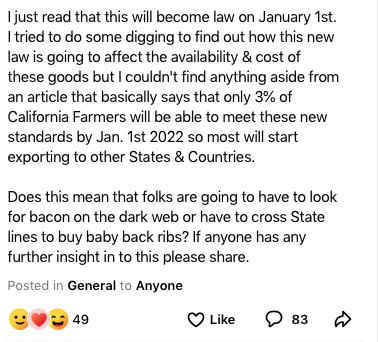
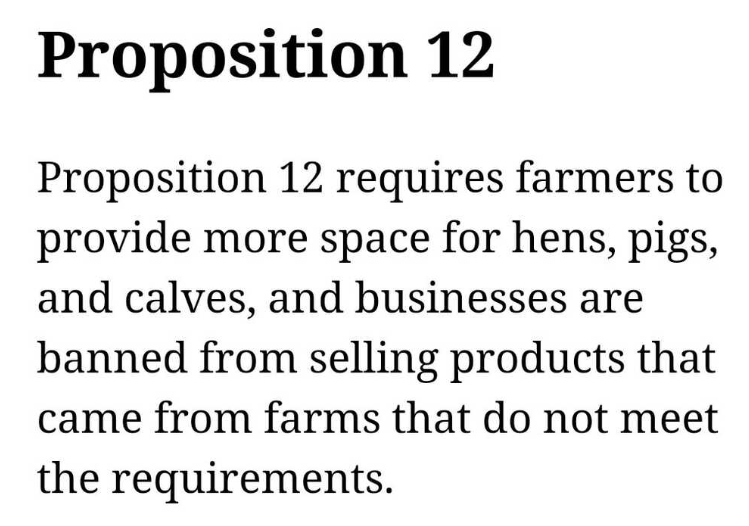
This was comment #83 on NextDoor -- mine -- after 82 previous comments from a bunch of smugs thrilled to bits about this law; many vegan and happy there might be less meat-eating (and never mind how that might play out):
No, nobody give the slightest thought to how it this might affect the poor and low-income. I am for humane treatment (and by that I mean humane living conditions and slaughter for animals we eat), but basically "progressive" voters passed a measure that is likely to cause a shortage of pork products as well as a skyrocketing of prices. Those who will be most affected mostly are unaware.People who want everyone to eat in a way that suits their ethics -- including people who scrape to afford food -- could put money behind this and buy bacon for others that comes from pigs raised with ample space and other standards. What is really awful is their voting in a law with unintended consequences, just when food prices have been escalating anyway.
I know about this, so I've stockpiled bacon, and thanks for the reminder to order a dozen more packs before December 31 -- before bacon either becomes unavailable or sold for Ritz-Carlton-type prices.
Linktartica
December 23, 2021Old Venice houses have these wall heaters and mine has two temperatures: The Everglades (minus the humidity) and Antarctica.
— Amy Alkon (@amyalkon) December 23, 2021
My current response to "Whaddya wanna do today?": "Stand in front of the heater holding my dog."
Elizabeth Warren: Senator And Mathematical Five-Year-Old
Sorry for the brief tweet post. It's nearly 10 Wednesday and I have yet to stop. Working on digging out!
LOL. Elizabeth Warren says grocery stores "appear to be passing on costs" to consumers.
— Jonah Goldberg (@JonahDispatch) December 21, 2021
Retail, how does it work? https://t.co/or0nKViu0V
Linklosin' It
December 22, 2021You know you're having a truly bad time at the post office when you give serious thought to whether you should just take your package (a return you're attempting to mail) out to the parking lot and light the contents of it on fire.
— Amy Alkon (@amyalkon) December 22, 2021
Nothingburgers Put Forward As Science
Really good piece by Tom Mullen at FEE (just as I'm going back through Kuhn for one of my two next books):
On a rare occasion where the largely useless national media confronted Fauci with a question about how Texas could be doing so well four weeks after abandoning all Covid restrictions, he had no answer. "Maybe they're doing more outside," he mused. Then, he went on recommending the same policies as if the question had never been posed.Fauci wasn't alone. When White House coronavirus advisor Anthony Slavitt was asked why locked down and masked California and restriction-free Florida were having similar results in terms of Covid spread, he began his answer with perhaps the only honest words that have escaped a public health official's mouth: "There is so much of this virus that we think we understand, that we think we can predict, that is just a little bit beyond our explanation." But then, in literally the same breath, he said we do know masking and social distancing work.
Now, you don't have to be a trained journalist for the obvious follow-up question to occur to you: "No, Mr. Slavitt, the question I just posed to you suggests we don't know masking and social distancing work because we are seeing equivalent results in states that are and are not following those policies."
Of course, that follow-up was not put to Slavitt. And you really have to ask yourself why.
The Problem With Blindly Trusting "The Science"
The failure of scientists to be scientific is not a new phenomenon. Thomas Kuhn's The Structure of Scientific Revolutions (1962) dealt directly with the tendency of scientists to reject evidence that contradicts the prevailing theory or "paradigm.""Part of the answer, as obvious as it is important," wrote Kuhn, a Harvard educated philosopher of science, "can be discovered by noting first what scientists never do when confronted by even severe and prolonged anomalies. Though they may begin to lose faith and then to consider alternatives, they do not renounce the paradigm that has led them into crisis."
...Kuhn's overall thesis challenged the prevailing understanding at the time that science proceeds in a linear fashion, with new discoveries incrementally adding to the accumulated knowledge that preceded them. Instead, argued Kuhn, science throughout history has featured a series of revolutions, where paradigms like the geocentric theory of the solar system or Newtonian physics collapsed under the weight of "anomalies" (evidence which contradicted the theory) and made way for new paradigms like the heliocentric theory of the solar system and Einsteinian physics.
There is much nuance in Kuhn's argument which his critics have tended to ignore, but one takeaway that we're seeing proved in real time is that these scientific revolutions are only revolutionary because of the tendency for scientists to cling to a theory regardless of evidence that refutes it. Kuhn argues that scientists will not abandon a disproven theory until a new theory is presented that they are convinced explains the evidence better than the old.
This New Normal paradigm can't collapse in the face of anomalies, no matter how numerous they are, because the anomalies are now simply ignored.
What makes the New Normal so strange is that a scientific revolution occurred with no anomalies. It was firmly established by a century of scientific research that suggested nonpharmaceutical interventions weren't effective in combating respiratory viruses. Indeed, Fauci himself initially repeated the established scientific consensus that lockdowns and mask mandates were not effective policy responses. He even discouraged people from voluntarily wearing masks.
Then, he and the rest of the government scientists did a complete about face. There was no new evidence that motivated this. They simply abandoned the prevailing scientific consensus based on a desire to do something - even though the scientific evidence before, during, and after the outbreak of Covid-19 said what they wanted to do wouldn't work. As a result, there is now a New Normal paradigm based on...nothing.
Linkpacking
Perfect companion to Kuhn above.
December 21, 2021Upton Sinclair on professional biases
— richard shotton (@rshotton) December 21, 2021
In The Week pic.twitter.com/HqF3mfI3BR
Spreading The Ugly For Retweets
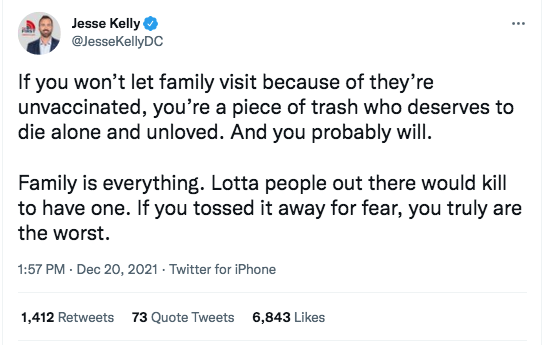
I'm fully vaccinated but I understand that people have meaningful reasons -- whether or not I agree with them -- for not being vaccinated, just as others have circumstances that prohibit them from just being all, "Hey, relatives! No vax, no problem!"
Kelly's tweet is ugly and unhelpful -- and as, I see it, a way to signal to the tribe-slash-mob with childish blanket statements.
This basically translates to:
"Hey, everybody, come on over. Sure, grandpa's immuno-compromised, but look on the bright side! If he dies, there's an inheritance to be had that much faster!"
Linketh Paltrow
December 20, 2021So is this a companion piece to Gwyneth's vagina candle? A candle that smells like a ball sack? pic.twitter.com/CVBGO4SVfO
— Andrea Kuszewski 🧠 (@AndreaKuszewski) December 20, 2021
The (Still) Roiling Brain
Motion-sickness took me out -- gotta sleep all day Friday. (I get it in a way nobody imagines is even possible!) Sorry I couldn't post!
No post Friday night, either. Getting better but still out of it.
Sunday: Still making up for its bite out of my work week, so no post tonight.
December 19, 2021Way To Help Amp Up The Divisiveness In This Country!
I'm no employment lawyer (though I used to study in the U of M law library to try to meet cute older dudes). However, with my admittedly passing and possibly incorrect ideas about employment law,I suspect it's within the rights of bosses on the show to hire and fire as they choose.
Oh, and what's with the "ban"? It's like that ridiculousness of people say you're a "b*tch," as if calling you a bitch is on the politer side if they don't type the "i."
Johnston, Fox and the staff of Bob's Burgers have never publicly confirmed that that was, in fact, Johnston's face that the FBI published in a poster soliciting tips about a possible riot suspect. Johnston has not been arrested or charged with a crime. https://t.co/WAQQKIsmvd pic.twitter.com/HRKtHPjKyz
— The Daily Beast (@thedailybeast) December 18, 2021
To sum up: This guy has not been accused of a crime. What the photo suggests: He was there at the Dec. 6 rampage on the capital. Also, he very likely has political views on the other end of the spectrum from probably everybody else on the show (save for any hidden conservatives who are too afraid of losing everything to disclose their politics).
The surely unintended consequences: Energizing people on the right against the left. I'm neither right nor left (as a libertarian), but I'm disgusted by the ugliness in this country: people deeming others with differing politics basically evil or human trash. This seems to add to it.
Linkbelly
December 16, 2021The Department of Muffin-Top Management?
— Amy Alkon (@amyalkon) December 19, 2021
Cultural Appropriation" Is A Form Of Flattery -- If You Use Your Head As More Than A Hatrack
What a bunch of tripe.
This awesome woman -- Kim Kardashian -- who works for prison reform gets knocked for "appropriating" black culture.
Culture does not have gates around it and America is great to a great extent for all the mixing of cultures.
I'm waiting Ashkenazi Jews to be told that they are committing a cultural crime by making ravioli!
From the Kerrie Justich piece at Yahoo:
Kim Kardashian is addressing claims that she's appropriated Black culture, sharing in a new interview with i-D magazine that she never meant to do so."Obviously, I would never do anything to appropriate any culture," she said in response to a question about navigating accusations of blackfishing. "But I have in the past got backlash from putting my hair in braids and I understand that. Honestly, a lot of the time it comes from my daughter asking us to do matching hair."
It was back in 2018 that Kardashian was criticized for wearing her hair in Fulani braids and referring to the style as "Bo Derek braids" after another white woman who stole the look from African culture. Still, Kardashian explained to i-D that she's had conversations with her 8-year-old daughter North West about wearing different hairstyles.
"I've had these conversations with her that are like, 'Hey, maybe this hairstyle would be better on you and not on me.' But I also want her to feel that I can do a hairstyle with her and not make it that big of a deal either if that's something that she's really asking for, and really wants," the 41-year-old mother of four explained. "But I've learned and grown over the years and figured out good ways to communicate with all my kids about all this. I've definitely learned over time, and I've tried to pass that culture of learning onto my kids too."
I wear kimonos because they are beautiful. I buy some at my Japanese neighbor's garage sale. Should I pass those by because I'm not Asian?
By the way, regarding my ravioli crack -- a situation that does not happen -- only some groups get "precious-ized": as if they are fragile infants who need "adult" protection. Vile.
Linkropology
December 15, 2021Laughing at bit in roughed-out paragraph in a long-ago-started (but unfinished) question for my science-based advice column:
— Amy Alkon (@amyalkon) December 15, 2021
"Research by SOME HAIRY ANTHROPOLOGIST finds that..."
I Fucking Love J.K. Rowling
As my Quillette writer colleague Holly Ash puts it at NKB:
J.K. Rowling refuses to cave to the woke mob that wants to erase woman in the name of transgender ideology.
Her tweet:
War is Peace.
— J.K. Rowling (@jk_rowling) December 12, 2021
Freedom is Slavery.
Ignorance is Strength.
The Penised Individual Who Raped You Is a Woman.https://t.co/SyxFnnboM1
Ash:
This lady gets it. Orwell would be proud.Then again, Rowling created a world in Harry Potter that showcases how authoritarianism and segregation occur in society. The very things she warned about by portraying the rise of the evil wizard Voldemort are now happening in our world today.
From the article Rowling shared:
Police have been criticised for saying they will record rapes by offenders with male genitalia as being committed by a woman if the attacker "identifies as a female".
Police Scotland said that they would log rapes as being carried out by a woman if the accused person insists, even if they have not legally changed gender.
...Twitter went haywire at Rowling's words, coming out en masse to [checks notes] defend rapists.
Rowling might be a billionaire, but her refusal to bow to the woke has left her inundated with death threats and threatened with excommunication from "high-class" society.
HaLinkvah
("Hatikvah is the Israeli national anthem.)
December 14, 2021Palestinians should try to emulate the Israelis (Jews, Druze, and Christians) rather than being focused on annihilating the Jews. Non-Jews who live in peace in Israel do very well. https://t.co/QtfiPQpqjM
— Amy Alkon (@amyalkon) December 13, 2021
How The Poor Get "Justice" Instead Of Justice
Latest: Using a notoriously unreliable field test, two Atlanta cops claimed that sand from a woman's stress ball tested positive for cocaine.
— CJ Ciaramella (@cjciaramella) November 16, 2021
She spent nearly six months in jail, four of them *after* a crime lab concluded it was sand https://t.co/Ibe2w14AjC


